3/24 Station Rd, Indooroopiliy. Brisbane 4068
3/24 Station Rd, Indooroopiliy. Brisbane 4068
Most of us are now sitting more than ever before. Between commuting, office work, and scrolling on our phones, the average person spends over 10 hours per day in a seated position.
Just like smoking was the health crisis of the 20th century, poor posture is quickly becoming the health crisis of the 21st century, and the effects are just as serious.
When you sit for extended periods, especially with poor posture, your body adapts to this position. The muscles in your hips and front of your thighs become tight, while your glutes and core become weak.
Over time, this creates an imbalance that affects your entire body:
Your head shifts forward, placing extra strain on your neck muscles. For every inch your head moves forward, it adds approximately 4.5kg of workload on your spine.
Shoulders roll forward, shortening the chest muscles and weakening the upper back. This is often seen in people who spend hours typing on computers.
Prolonged sitting can reduce the natural curve in your lumbar spine, leading to disc pressure and lower back pain.
Many people think that a quick stretch at their desk is enough to counteract hours of sitting. While stretching helps, it doesn't address the root cause of postural problems.
The reality is:
At Healthspan Chiropractic & Wellness, we take a comprehensive approach to posture correction.
Treatment may include:
Try this simple routine every day to counteract the effects of sitting:
Poor posture doesn't have to be your reality. With the right treatment and guidance, you can improve your posture and reduce pain.
Our team at Healthspan Chiropractic & Wellness can help you develop a personalized plan to achieve better posture and spinal health.
Book a ConsultationDisclaimer: This article is for informational purposes only and does not constitute medical advice. Always consult a qualified health professional before commencing any new treatment.
Across Brisbane, chiropractors are seeing a dramatic increase in neck and back pain, particularly among professionals who spend long hours at desks.
Most people assume the cause is injury. In reality, the most common cause is posture overload.
When you sit at a computer or look down at a phone for hours each day, your spine slowly shifts out of alignment. Over time this creates:
Left untreated, these issues can become long-term structural problems.
At Healthspan Chiropractic & Wellness in Indooroopilly, many patients present with these exact symptoms after months or years of desk-based work. Learn more about how poor posture affects your spine.
Forward head posture is one of the biggest drivers of modern spinal problems.
Your head weighs around 4–5kg. But when your head moves forward just a few centimetres while working at a screen, the effective load on your spine can increase dramatically.
This leads to:
Over time, this can trigger headaches, fatigue and chronic neck pain.
Yes, when the underlying issue is spinal alignment and joint restriction.
At Healthspan, treatment begins with a comprehensive consultation and assessment to determine the cause of the pain. Learn about our treatment approach.
Depending on the individual, treatment may include:
These techniques aim to restore mobility in the joints and reduce pressure on nerves.
Many patients report improvements in:
Before pain becomes chronic, small changes can make a big difference.
If you experience any of the following regularly, it may be time to seek professional advice:
Early treatment often leads to faster recovery.
With over 30 years of experience treating Brisbane patients, Healthspan Chiropractic & Wellness focuses on helping people restore movement, reduce pain and improve long-term spinal health.
Book a ConsultationDisclaimer: This article is for informational purposes only and does not constitute medical advice. Always consult a qualified health professional before commencing any new treatment.
Many people suffering from headaches treat the symptom, not the cause.
Painkillers may temporarily reduce the pain, but they rarely address what triggered the headache.
One of the most common causes is tension in the neck and upper spine.
These headaches are known as cervicogenic headaches.
They typically present as:
Your neck contains nerves that communicate with the head and upper body.
When the joints in the cervical spine become restricted or misaligned, they can irritate surrounding nerves and muscles.
This can trigger:
Restoring normal movement in the neck often reduces the frequency of these headaches.
Chiropractic care focuses on improving movement in the spine.
At Healthspan Chiropractic & Wellness, treatment may include:
The goal is to reduce the mechanical stress contributing to the headaches.
Many patients report improvements not just in headaches, but also:
Your headaches may be linked to spinal dysfunction if they:
These are classic signs of tension or cervicogenic headaches.
If headaches occur regularly, it's worth identifying the underlying cause. Learn how we can help.
A spinal assessment can determine whether neck dysfunction is contributing to your symptoms.
Healthspan Chiropractic & Wellness has been helping Brisbane patients manage spinal-related headaches for over three decades.
If headaches are affecting your work, sleep or daily life, addressing the root cause can make a significant difference.
Book a ConsultationDisclaimer: This article is for informational purposes only and does not constitute medical advice. Always consult a qualified health professional before commencing any new treatment.
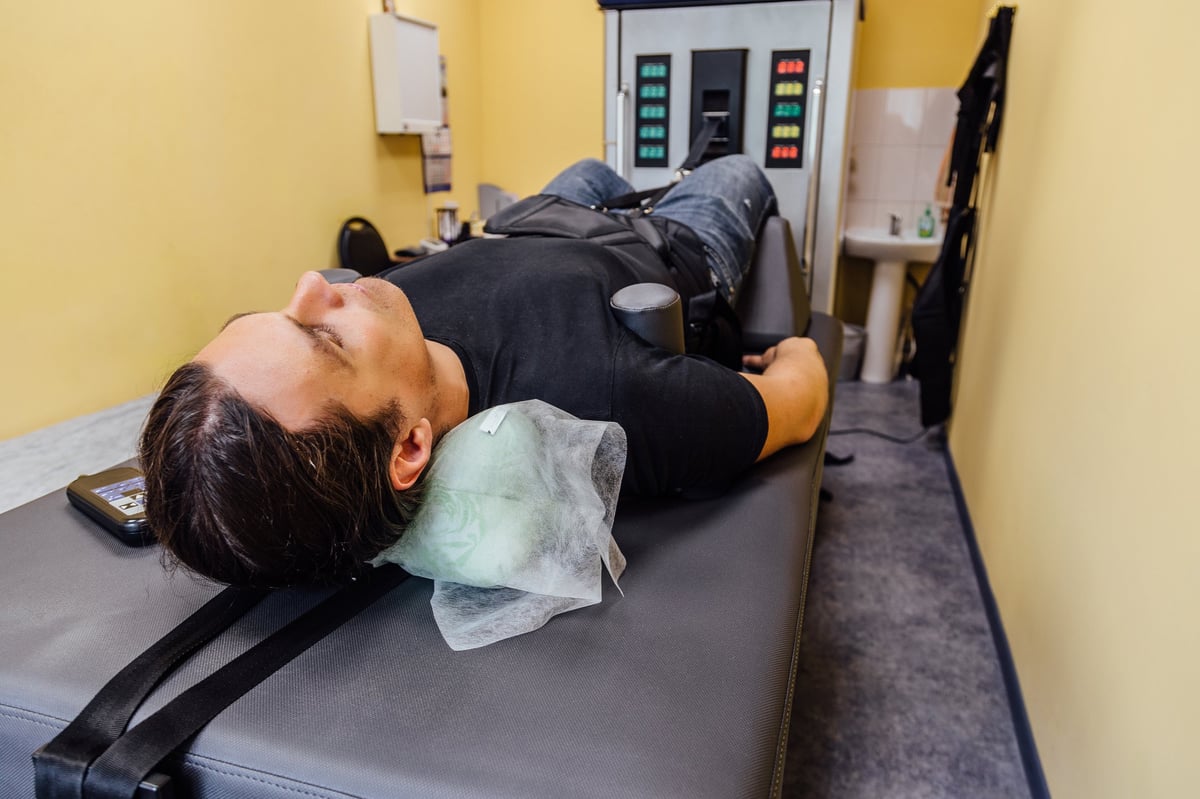
If you've come across a chiropractic video online lately, there's a good chance you've seen the Y strap in action. That satisfying pull along the spine, often followed by a series of audible releases, has made the Y strap one of the most talked-about tools in modern chiropractic care. But what exactly is it, how does it work, and could it help you? Here's everything you need to know.
The Y strap, formally known as the Y-axis traction strap, is a specialised chiropractic device used to decompress the spine. It gets its name from two things: its Y-shaped design, and the direction it works along, the body's Y-axis, which runs vertically along the spine.
When fitted to a patient, the lower section of the strap cradles the back of the head and base of the skull. The two upper arms of the "Y" connect to a handlebar that the chiropractor grips during the adjustment. Together, this design allows the chiropractor to apply a controlled, straight traction force along the length of the spine, no twisting, no rotation, just a clean pull. Learn more about our spinal decompression techniques.
The process is straightforward and comfortable for most patients:
The type and amount of force used is tailored to each individual. Every spine is different, and a good chiropractor adjusts the technique to suit your comfort level and specific needs.
That satisfying pop you hear (and feel) is called cavitation. It happens when the joint spaces in your spine rapidly expand during the adjustment, causing gas bubbles to release from the synovial fluid between joints. It's the same mechanism behind knuckle cracking — completely harmless, and for many people, immediately relieving.
The Y strap offers several benefits, particularly for people dealing with spinal compression or disc-related issues:
An additional advantage of the Y strap over traditional rotational adjustments is the straight, torsion-free angle of force. Many patients who find rotational neck adjustments uncomfortable find the Y strap much easier to tolerate.
The Y strap is particularly well-suited for people experiencing:
Some patients feel the effects all the way down to the tailbone, making it beneficial for lower back concerns as well.
When performed by a qualified, experienced chiropractor, the Y strap is considered safe for most patients. The key is proper assessment and a customised approach — the force applied should always match the patient's individual condition and comfort level.
That said, the Y strap is not suitable for everyone. It is generally not recommended for people with consulting your chiropractor to determine if this treatment is right for you:
This is why a thorough health assessment before your first session is essential. Your chiropractor will review your history, examine your spine, and determine whether the Y strap is appropriate for you, and at what level of force.
First-timers are often a little nervous, the strap looks more dramatic than it feels. Your chiropractor will walk you through exactly what will happen before anything begins, and the adjustment itself typically takes only a few minutes as part of a broader treatment session. Meet our experienced team.
Most patients report feeling immediate relief, reduced tension, and greater ease of movement after their first session. Some conditions respond best to a course of treatments, and your chiropractor will recommend a care plan based on your assessment.
For most people, no. The sensation is more of a strong stretch than anything painful. Some mild soreness for a day or two after is normal, similar to what you might feel after a good workout.
Traditional manual adjustments often involve rotation or side-bending of the neck. The Y strap is unique because it works in a straight line along the vertical axis, no twisting involved. Many patients prefer this, especially those with sensitive necks. Learn about our other treatment options.
Some people notice significant improvement after a single session. Others benefit from a series of treatments. Your chiropractor will develop a personalised plan after your initial consultation.
No. The audible release is a common outcome, but it isn't the goal of the adjustment and doesn't need to occur for the treatment to be effective.
If you're dealing with neck pain, back stiffness, headaches, or the effects of compressed discs, the Y strap may be exactly what your spine has been waiting for.
At Healthspan Chiropractic & Wellness, our experienced team offers Y strap adjustments as part of a comprehensive, personalised approach to chiropractic care. We take the time to assess your condition thoroughly and explain every step of your treatment before we begin.
Book NowDisclaimer: This article is for informational purposes only and does not constitute medical advice. Always consult a qualified health professional before commencing any new treatment.